Author name: admin

Your Competitor Is Not Always Better — They May Just Be More Visible
Blog

Your Competitor Is Not Always Better — They May Just Be More Visible

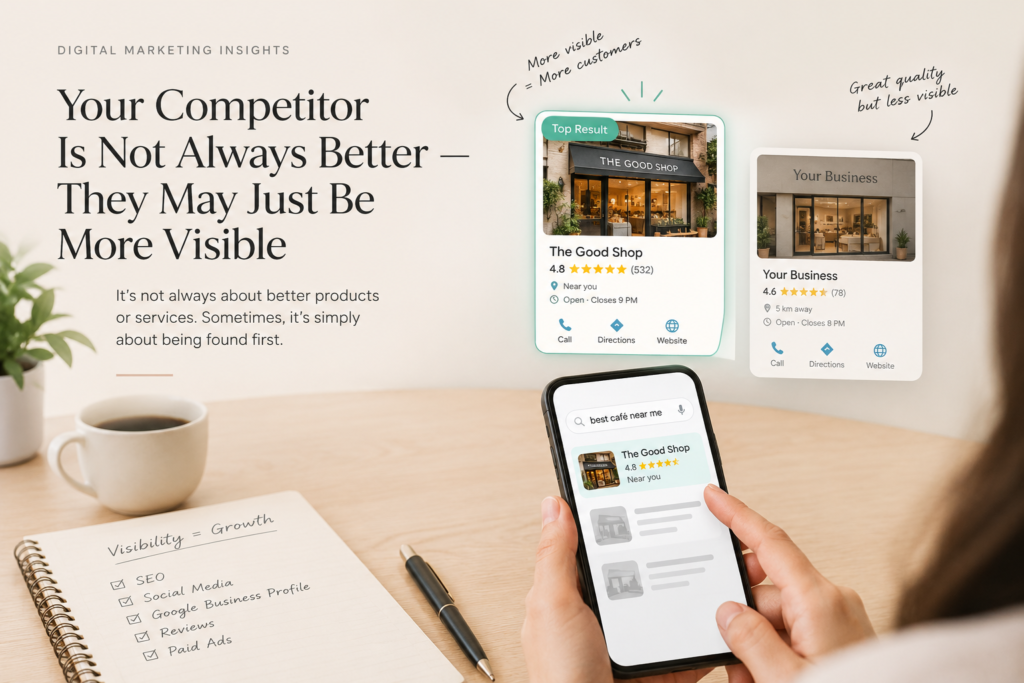
Your Competitor Is Not Always Better– Every business owner has had this moment: you’re confident your product is better, your service is more reliable, your pricing is fairer — yet a competitor keeps showing up first. They get the calls. They get the clicks. They get the customers who never even knew you existed. It’s tempting to conclude they must be doing something fundamentally better. Often, they’re not. They’re simply more visible — and in today’s market, visibility often decides who gets discovered before quality ever gets the chance to prove itself. The Discovery Problem: Customers Can’t Choose What They Can’t See Buying decisions used to start with word of mouth or a walk down the street. Today, they start with a search bar, a map app, a social feed, or a quick “let me look that up.” This shift means: Visibility isn’t vanity — it’s the gateway to being considered at all. No matter how strong your product is, it can’t compete in a decision the customer never knew was happening. Why Visibility Gets Mistaken for Superiority Several psychological and practical dynamics reinforce the “visible = better” illusion: 1. The Mere-Exposure Effect People tend to trust and prefer things they’ve seen before — even if that familiarity comes purely from repeated exposure, not proven quality. A competitor who advertises consistently or ranks well simply feels more credible. 2. Social Proof at Scale More visibility usually means more reviews, more mentions, more shares. This creates a compounding effect: visibility generates social proof, and social proof generates more visibility. Customers read this cycle as evidence of quality, when it may just be evidence of reach. 3. The “First Option Wins” Bias Search results, marketplace listings, and app store rankings are consumed top-down. Being first or near the top doesn’t just get more clicks — it frames that option as the default choice, shifting the burden of proof onto every alternative. 4. Algorithmic Amplification Platforms (Google, Instagram, Amazon, TikTok, review sites) reward existing visibility with more visibility. Businesses that are already ranking well get pushed further ahead, while newer or lower-visibility competitors have to work harder just to be seen — regardless of actual product quality. How Online Visibility Shapes the Customer Discovery Journey Customer discovery today typically follows a pattern: Awareness → Consideration → Comparison → Decision. Visibility affects every stage. Stage What Visibility Controls Awareness Whether the customer even learns you exist (SEO, ads, social presence, local listings) Consideration Whether you make it into their shortlist of options they’re seriously comparing Comparison How much information (reviews, content, case studies) they can find about you versus competitors Decision Which option feels the safest, most credible, or most “obviously right” based on visible signals If a competitor dominates even one of these stages — say, they rank higher in search or have ten times the reviews — they can win the customer before a genuine side-by-side comparison of value ever happens. The Channels Where This Plays Out What This Means for Businesses The uncomfortable truth is that being good is not the same as being findable. If your competitor is winning, it’s worth auditing: Improving visibility doesn’t mean compromising on quality — it means making sure quality has a fair chance to be seen and compared in the first place. The Takeaway Losing a customer to a competitor doesn’t always mean losing on merit. Often, it means losing on exposure — before the comparison even started. Visibility shapes discovery, discovery shapes consideration, and consideration is where deals are won or lost. The businesses that win consistently aren’t always the objectively “best.” They’re the ones who made sure they could be found, compared, and chosen — and then let their quality close the deal. Your product might be better. Make sure people can actually see that.
Google Ads for Small Businesses
Blog

Google Ads for Small Businesses: Is It Worth the Investment?

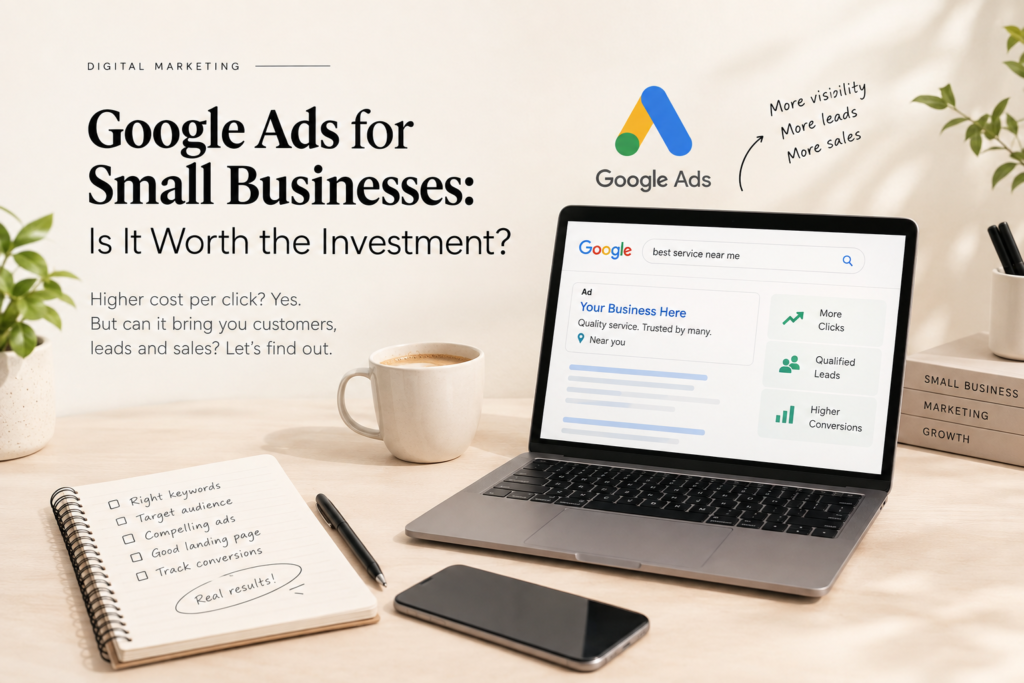
Google Ads: For small businesses, advertising can feel like a difficult investment decision. You may have a limited marketing budget and naturally want to know where your money will work harder. When comparing Google Ads with social media advertising, Google Ads can sometimes appear more expensive. The cost per click can be higher, especially in competitive industries. But there is a bigger question that business owners should ask: Is the advertising bringing you customers, leads, and sales? That is where Google Ads can become a valuable marketing channel for small businesses. Google Ads is not necessarily the cheapest advertising option. However, when it is properly planned, targeted, and measured, it can help businesses reach people who are already looking for the products or services they offer. Google Ads vs SMM: What’s the Difference? Google Ads and social media marketing serve different purposes, so comparing them only based on cost doesn’t always give the complete picture. Social Media Marketing (SMM) platforms such as Instagram and Facebook are excellent for creating awareness and getting your brand in front of potential customers. Ads can be shown based on factors such as interests, demographics, behaviours, and online activity. Google Ads works differently. It can put your business in front of people who are actively searching for something you provide. For example, imagine someone is scrolling through Instagram and comes across an advertisement for a dental clinic. They may notice the advertisement, but they may not be planning to visit a dentist at that moment. Now consider someone searching on Google for: “Best dentist near me” That person already has a problem or requirement and is actively looking for a solution. This difference in search intent is one of the biggest strengths of Google Ads. Social media can help create demand and awareness. Google Search can help capture existing demand. Why Can Google Ads Be More Expensive? One of the first things small-business owners notice about Google Ads is that some clicks can be expensive. This is mainly because advertisers compete for valuable search terms. The cost of a click can be influenced by several factors, including: For example, a keyword related to a highly competitive service in a major city may cost considerably more than a less competitive local keyword. But a higher cost per click (CPC) does not automatically mean that the campaign is unsuccessful. Imagine spending ₹50 to generate a click that has a good chance of becoming a customer, compared with spending ₹5 on a click from someone who has no real interest in buying. The cheaper click isn’t necessarily the better click. What matters is what happens after the click. This is why businesses should evaluate Google Ads based on metrics such as leads, sales, conversion rate, customer acquisition cost, and return on ad spend—not CPC alone. 4 Major Benefits of Google Ads for Small Businesses 1. Reach People With High Purchase Intent One of the biggest advantages of Google Ads is that you can reach people at the moment they are searching for a solution. Someone searching for: “AC repair service near me” is likely to have a much stronger immediate need than someone who simply sees an AC service advertisement while scrolling through social media. This doesn’t mean every search will become a customer. However, search intent can make Google Ads particularly valuable for businesses where customers actively search before making a purchase or enquiry. 2. Generate More Relevant Leads Google Ads allows businesses to build campaigns around relevant keywords, locations, services, and audiences. Instead of simply trying to reach as many people as possible, you can focus on reaching people who are more likely to need your product or service. For a local business, for example, targeting searches within a specific service area can help reduce irrelevant traffic. The goal isn’t to get thousands of clicks. The goal is to get the right clicks from people who could actually become customers. 3. Start Generating Traffic Faster Building visibility through organic search can take time. SEO is extremely valuable for long-term growth, but businesses often need a way to reach potential customers while their organic visibility is still developing. This is where Google Ads can help. Once a properly configured campaign is approved and running, your ads can begin appearing for relevant searches and sending targeted visitors to your website or landing page. However, faster traffic does not automatically mean faster sales. Your results still depend on factors such as your targeting, advertisement, offer, landing page, pricing, competition, and sales process. 4. Measure Where Your Money Is Going Another major advantage of digital advertising is the ability to measure performance. With proper conversion tracking, businesses can monitor actions such as: This gives you a clearer picture of what your advertising budget is actually producing. For example, instead of simply saying: “We spent ₹25,000 on Google Ads.” you can ask: “How many qualified leads did that ₹25,000 generate, and how many of those leads became customers?” That is a much more useful business question. Is Google Ads Suitable for Every Small Business? Google Ads can be highly effective, but it isn’t a magic solution for every business. Its effectiveness depends on several factors, including whether people are actually searching for your product or service. Google Ads can be particularly useful for businesses such as: However, simply running an advertisement doesn’t guarantee results. Your campaign needs the right combination of: Search demand + targeting + keywords + compelling ads + landing page + conversion tracking + a strong offer. If there is very little search demand for your product, Google Search Ads may not be the best starting point. In such situations, social media advertising can sometimes be more useful for introducing the product and creating awareness. Google Ads and SMM: Why Not Use Both? One of the biggest mistakes businesses make is treating Google Ads and social media marketing as if they are competing channels. They don’t necessarily have to compete. They can work together. Think about the

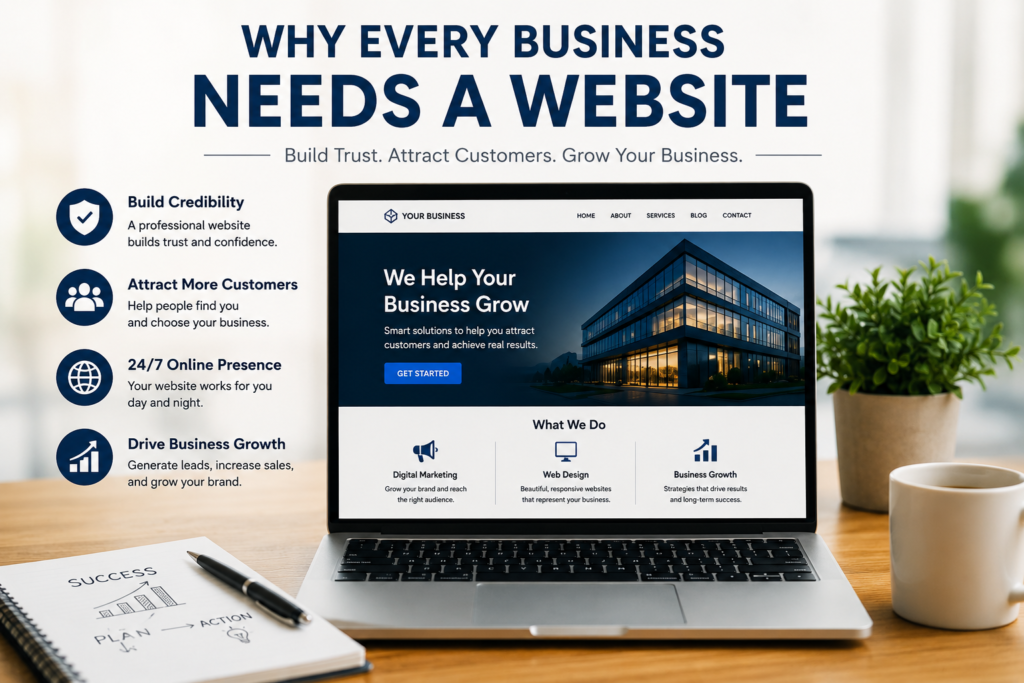
Why Every Small Business Needs a Website
Blog

Why Every Small Business Needs a Website: The Key to Building Trust and Driving Business Growth

Introduction Every Small Business Needs a Website because it is the foundation of a strong online presence and a key driver of business growth. Many small business owners believe that having a social media page is enough to build and grow their business. With platforms like Instagram, Facebook, and TikTok attracting millions of users every day, it’s easy to assume that a website is no longer necessary. However, this is one of the biggest misconceptions in today’s digital world. Social media is an excellent tool for attracting attention and connecting with potential customers, but it cannot replace a professional business website. A website represents your brand, builds credibility, showcases your products or services, and provides customers with everything they need to make informed decisions. Modern customers expect businesses to have a professional website. Before making a purchase or contacting a company, they often search online to learn more about the business, compare options, read reviews, and determine whether the brand is trustworthy. If your business doesn’t have a website, you could be losing potential customers before they even contact you. Every Small Business Needs a Website to build trust, improve online visibility, and create more opportunities for long-term business growth. The Modern Customer Journey Today’s customers rarely make instant purchasing decisions. Instead, they research before buying. Every Small Business Needs a Website because most customers begin their buying journey with an online search. Whether someone is looking for a product, a local service, or a professional solution, their first step is usually to search online. They want answers to questions like: What does this business offer? Can I trust this company? What do previous customers say? What are the prices? How can I contact them? Are they professional? A website answers all these questions in one place. Every Small Business Needs a Website because it provides customers with the information they need to make confident purchasing decisions. Without a website, customers often need to search through social media posts, send messages, or wait for replies. Many people simply don’t have the time or patience for that. If finding information becomes difficult, they may choose a competitor whose website makes everything easy to access. That’s another reason Every Small Business Needs a Website to build trust, improve customer experience, and win more business. First Impressions Matter Your website is often the first interaction customers have with your business. Just like a clean and attractive physical store creates confidence, a professional website gives visitors a positive first impression. A modern website communicates that your business is: Professional Reliable Established Trustworthy Customer-focused People naturally feel more confident purchasing from businesses that present themselves professionally online. Even if two businesses offer similar products or services, customers often choose the one with the better website because it creates greater confidence. Why Social Media Alone Isn’t Enough Many businesses rely entirely on Instagram or Facebook to promote their products. While social media is important for marketing, it has several limitations. Customers may need to: Scroll through hundreds of posts. Search for product information. Read multiple captions. Send direct messages. Wait for business hours to receive replies. This creates unnecessary friction in the buying process. Social media platforms are designed for engagement—not for organizing detailed business information. A website, on the other hand, gives customers immediate access to everything they need without delays. Think of it this way: Social media attracts attention. A website converts that attention into customers. A Website Builds Trust and Credibility Trust is one of the biggest factors influencing purchasing decisions. When customers discover a business with a professional website, they immediately perceive it as more legitimate. A website allows you to display: Business information Contact details Products and services Customer testimonials Portfolio Certifications Awards Frequently Asked Questions Company history All of this helps visitors feel confident about choosing your business. Without a website, customers may question whether your business is genuine or established. Your Website Works 24/7 Unlike a physical store, a website never closes. Customers can: Browse your products Read about your services Submit inquiries Book appointments Request quotations Make purchases at any time of the day. Even while you’re sleeping, your website continues promoting your business and generating leads. This makes a website one of the most valuable long-term investments for any business. A Better Customer Experience Today’s consumers expect convenience. They don’t want to wait for replies or search through endless posts to find simple information. A well-designed website allows customers to: Find information quickly Compare products View pricing Check availability Read reviews Contact your business instantly The easier you make the buying journey, the more likely customers are to choose your business. Convenience often becomes the deciding factor between you and your competitors. A Website Strengthens Your Brand Your website is much more than an information page. It tells your brand story. Through professional design, colors, typography, images, and content, you create a memorable experience that reflects your business values. A consistent brand identity helps customers remember your business and builds long-term recognition. Unlike social media, where your content is mixed with countless other posts, your website provides a distraction-free environment focused entirely on your brand. Supports SEO and Digital Marketing A website is the foundation of every successful digital marketing strategy. Whether you’re investing in: Search Engine Optimization (SEO) Google Ads Social Media Marketing Email Marketing Content Marketing They all work best when directing users to a professional website. With proper SEO, your website can appear on Google when potential customers search for products or services related to your business. This helps you attract highly targeted visitors who are already interested in what you offer. Without a website, you’re missing valuable opportunities to generate organic traffic and quality leads. Helps Small Businesses Compete with Larger Brands One of the biggest advantages of having a website is that it creates equal opportunities. A small local business with a professional website can compete alongside larger companies in search results. Customers judge businesses based on professionalism—not just company size.

Affordable Digital Marketing for Local Shops
Blog

Affordable Digital Marketing for Local Shops

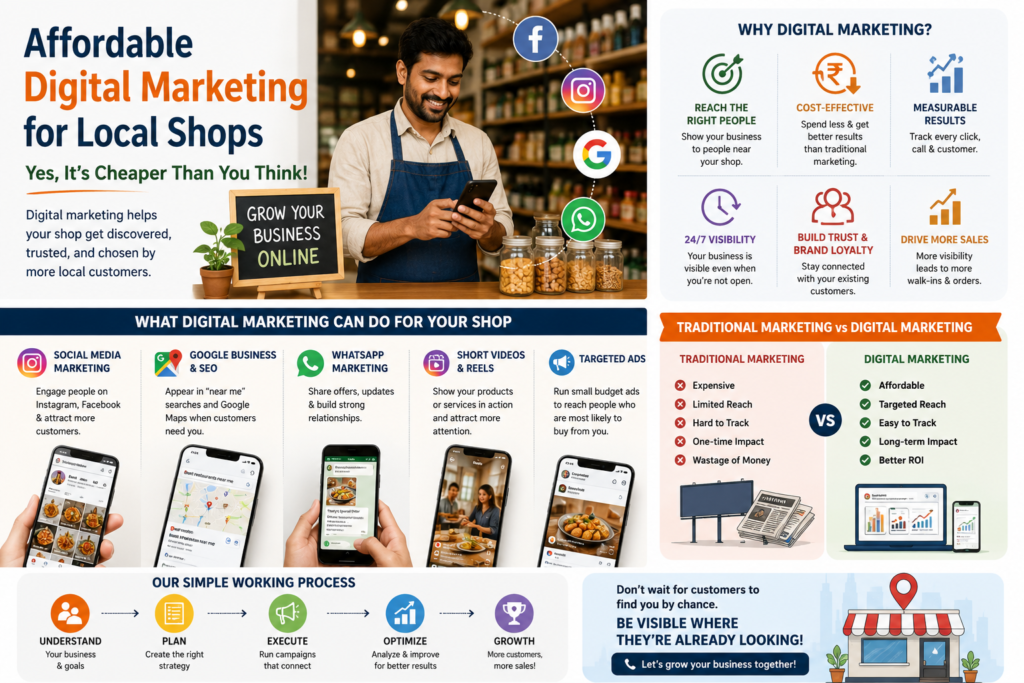
If you run a small shop, a restaurant, a salon, or any kind of local business, you’ve probably heard the term Affordable Digital Marketing for Local Shops. You may have also thought, “That sounds expensive. That’s for big companies, not for me.” This is one of the most common beliefs among local business owners. But it’s also one of the biggest misunderstandings. The truth is that Affordable Digital Marketing for Local Shops makes it possible to attract more local customers, build brand awareness, and increase sales without spending a fortune. In this blog, we’ll explain why many people believe digital marketing is expensive, why that isn’t true, and how Affordable Digital Marketing for Local Shops can help your business grow while staying within your budget. Why Do Shop Owners Think Digital Marketing Is Expensive? Let’s think about this from the shop owner’s point of view. Most local business owners have some experience with marketing — but usually, it’s traditional marketing. Things like: These methods have been around for a long time, and everyone knows one thing about them: they cost a lot of money. A single banner or a newspaper ad can cost thousands of rupees, and it only reaches people in one small area, for a limited time. So when someone mentions “digital marketing,” the shop owner’s brain naturally makes a comparison. They think, “If normal marketing is this expensive, digital marketing — with websites, social media, and technology — must be even more expensive.” It’s a completely understandable assumption. But it’s the wrong one. The Truth: Digital Marketing Is Actually More Affordable Here’s the reality — Affordable Digital Marketing for Local Shops is usually cheaper than traditional marketing, not more expensive. More importantly, it can be customized to match your budget and business goals. You don’t need a huge investment to get started. Affordable Digital Marketing for Local Shops allows you to create a strategy based on what you can afford—whether that’s a small monthly budget for social media marketing, a well-optimized Google Business Profile, or a local ad campaign that targets customers near your shop. This approach is very different from traditional marketing, where you often pay a large fixed amount regardless of the results. With Affordable Digital Marketing for Local Shops, you have greater control over your spending, more flexibility to adjust your campaigns, and access to real-time data that shows exactly what’s working and where your marketing budget delivers the best return. Why Digital Marketing Works So Well in Today’s World Think about your own daily habits for a moment. How many times a day do you pick up your phone? How many times do you scroll through Instagram, Facebook, or YouTube? Probably a lot — and so does everyone else, including your customers. This is exactly why digital marketing works so well today. People are spending hours every day on their phones, scrolling through content. If your shop, your brand, or your products show up during that scrolling, people start to notice you — even if they don’t buy anything right away. Over time, this builds familiarity. The next time they need something you offer, your business is already in their mind. That’s the power of consistent visibility. Traditional marketing can’t reach people this often, this personally, or this cheaply. People Often Buy Before They Even Search Here’s something interesting about how people shop today: many people see a product or brand somewhere — maybe in a reel, an ad, or a friend’s recommendation — and they decide they want it, even before doing any real research. But there’s also a second group of people: those who are actively searching for something they need. This is where SEO (Search Engine Optimization) becomes extremely important. Let’s say someone is travelling to a new city. They’re hungry, and they don’t know the area. What do they do? They open their phone and search “restaurants near me” or “best food near me.” Within seconds, a list appears — and they pick from those top results. The same thing happens for salons, repair shops, clothing stores, gyms, and almost every kind of local business. People search for exactly what they need, exactly when they need it. If your business appears in that search, you get a new customer. If it doesn’t, someone else — maybe a competitor down the street — gets that customer instead. SEO helps your shop show up in these searches, on platforms like Google, Google Maps, and other search engines. It’s like placing a signboard exactly where and when your customer is looking for you — not randomly on a highway, hoping someone drives by. What Kind of Digital Marketing Can Help Your Shop? The good news is, you don’t need to do everything at once. A good digital marketing plan is usually a mix of a few simple things, such as: None of these require a massive budget. Each one can be scaled up or down depending on what you can afford, and adjusted as your business grows. The Bottom Line Digital marketing isn’t the expensive, complicated thing that many local shop owners imagine. In comparison to traditional marketing, it’s actually more affordable, more flexible, and far more effective — especially because your customers are already spending hours every day on their phones. Whether people are scrolling and discovering your brand by chance, or actively searching for something they need right now, digital marketing puts your shop directly in front of them — at the right time, in the right place. So don’t wait for customers to stumble upon your shop by luck. Show up where they’re already looking. Want a customised digital marketing plan for your shop that fits your budget? Get in touch with us today — let’s grow your business together.

SEO For Business Growth
Blog

SEO For Business Growth 

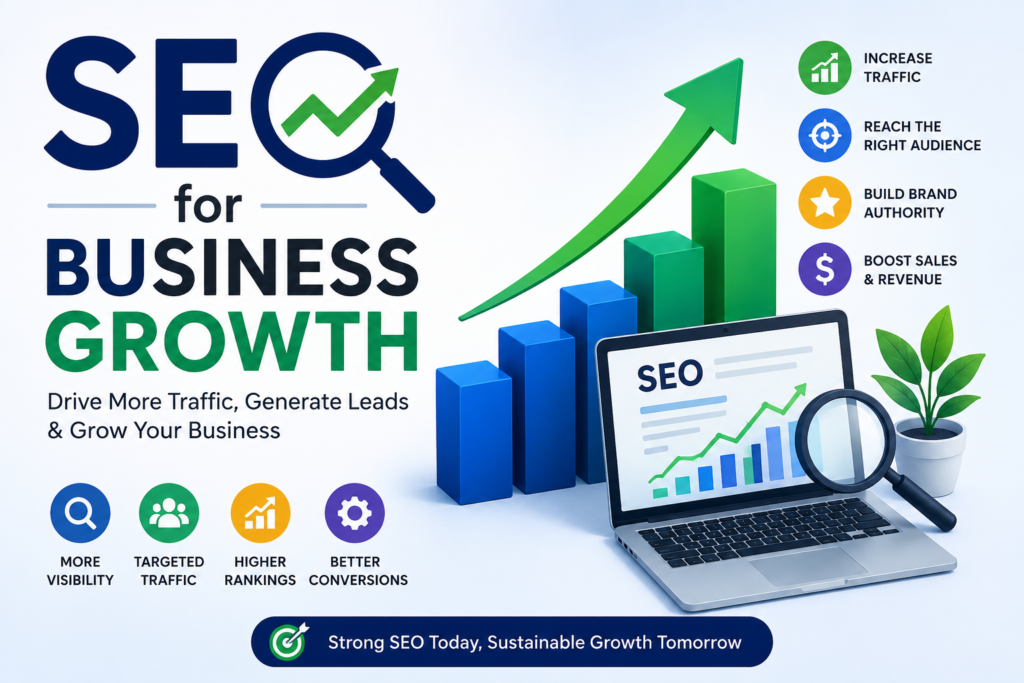
In today’s digital world, every business needs to grow, attract customers, and stay ahead of competitors. Whether you run a small-scale business or a large company, your online presence plays a major role in your success. This is where SEO for Business Growth comes in SEO is one of the most effective digital marketing methods for increasing website visibility, driving organic traffic, and turning visitors into customers. SEO provides long-term results that continue to benefit your business over time. In this blog, we’ll explore how SEO  helps businesses grow  and how your business benefits from investing in SE What is SEO  SEO is one of the most effective digital marketing methods for increasing website visibility, driving organic traffic, and turning visitors into customers. SEO provides long-term results that continue to benefit your business over time. In this blog, we’ll explore how SEO  helps businesses grow and how your business benefits from investing in SEO. For example, if you run a digital marketing agency and someone searches for”  ‘Best digital marketing agency,” strong SEO can help your website appear on the first page of Google. SEO includes  All of these factors work  together to help your website rank and attract more visitors  Why SEO Is Important For  Business Growth  Everyone searches online before making decisions, whether they are buying products or services. Without SEO for Business Growth, your website may not be seen by customers. Here’s why SEO is essential for business growth  Increased Website Traffic SEO for Business Growth helps your website rank for search terms. Higher rankings bring organic traffic to your website. Organic traffic is valuable because these visitors are already searching for things related to your business. They are already interested in what your business has to offer.  They are already interested in results related to your business Builds Brand Awareness When your business shows up in search results all the time, more people get to know your brand. Your business becomes familiar to them. Even if they do not click away, seeing your business repeatedly builds trust and recognition over time. Improves Credibility and Trust People trust websites that Google shows at the top. If your website is on the page, customers think your business is more trustworthy and professional. SEO also improves your website by making it faster, safer, and easier to use, which builds more trust. Generates High-Quality Leads SEO helps you to reach people who are searching for your services. These people are looking to buy, so they are more likely to become your customers. This means you have a chance of turning visitors into paying customers. Cost-Effective Marketing Strategy Unlike paid ads that stop working when you run out of money, SEO keeps bringing you visitors over time. Once your website ranks well, it can bring visitors for months or even years with minimal extra cost. This makes SEO a great investment for your marketing. How SEO Helps Business Growth Let’s break down how SEO supports business expansion. Better Online Visibility If customers can’t find your business online, they will choose competitors. SEO improves your visibility so your website appears when people search for keywords like SEO services. More visibility means: More traffic to your website • More inquiries from potential customers • More sales opportunities for your business Targets the Right Audience SEO focuses on reaching people who are actively looking for your products or services, such as SEO services for small businesses. For example: A bakery can target ” custom cakes near me” and attract local customers. A digital marketing agency can target people searching for “SEO services”. Get qualified leads. This targeted approach brings in people who’re interested in what you offer instead of random traffic. Improves User Experience Google rewards websites that provide user experiences SEO improves When visitors enjoy using your website they stay longer and are more likely to take action like contacting you for your services. Increases Conversion Rates SEO doesn’t just bring traffic—it attracts traffic. Visitors who find your website through search usually have a need, such as finding a digital marketing agency. If your website solves that need, they are more likely to contact you or make a purchase. Supports Long-Term Growth SEO builds momentum over time. Unlike short-term marketing tactics, SEO creates an online foundation that keeps growing. As your rankings improve, your traffic increases steadily, helping your business scale with SEO. Key SEO Strategies For Business Growth To grow your business through SEO strategies:Keyword Research Find keywords your customers search for, like business growth strategies. Use tools like: • Google Keyword Planner • Ahrefs • SEMrush • Ubersuggest Choose keywords with: • Search volume • Low to medium competition • High business relevance to SEO services High-Quality Content Creation Content is one of Google’s top ranking factors. Create blog posts, service pages, and guides that answer customer questions about SEO for business growth. Good content should: • Solve problems • Be easy to read • Include target keywords • Provide real value On-Page Optimization. Optimize • Page titles • Meta descriptions • Headers • Images • links • URL structure These help search engines understand your content better, like SEO services.

Scroll to Top