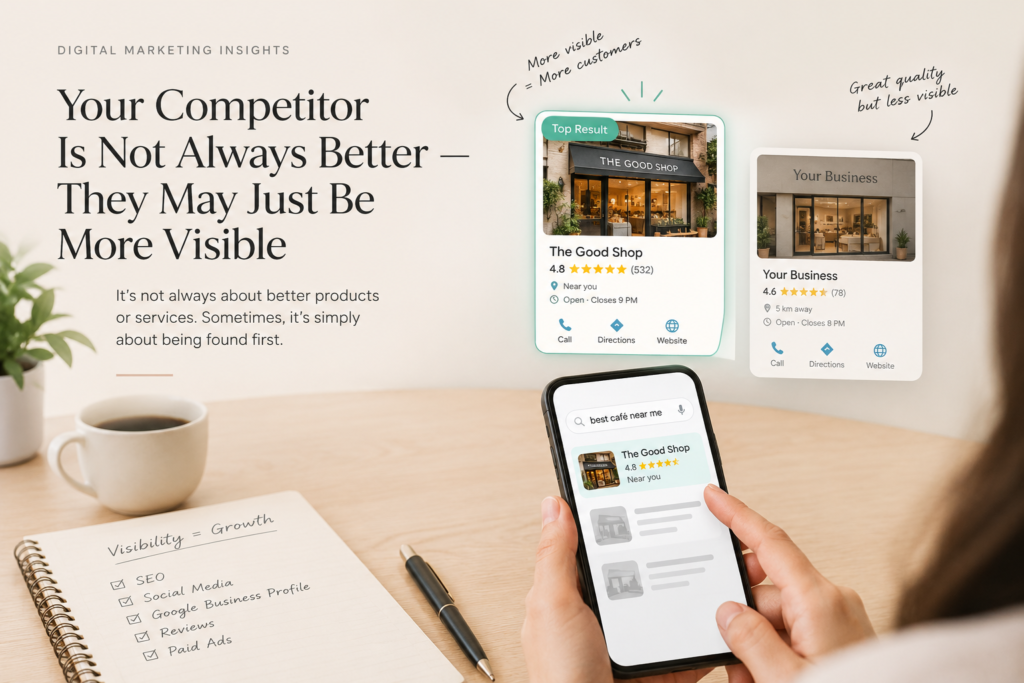
Your Competitor Is Not Always Better — They May Just Be More Visible
Your Competitor Is Not Always Better– Every business owner has had this moment: you’re confident your product is better, your service is more reliable, your pricing is fairer — yet a competitor keeps showing up first. They get the calls. They get the clicks. They get the customers who never even knew you existed. It’s tempting to conclude they must be doing something fundamentally better. Often, they’re not. They’re simply more visible — and in today’s market, visibility often decides who gets discovered before quality ever gets the chance to prove itself. The Discovery Problem: Customers Can’t Choose What They Can’t See Buying decisions used to start with word of mouth or a walk down the street. Today, they start with a search bar, a map app, a social feed, or a quick “let me look that up.” This shift means: Visibility isn’t vanity — it’s the gateway to being considered at all. No matter how strong your product is, it can’t compete in a decision the customer never knew was happening. Why Visibility Gets Mistaken for Superiority Several psychological and practical dynamics reinforce the “visible = better” illusion: 1. The Mere-Exposure Effect People tend to trust and prefer things they’ve seen before — even if that familiarity comes purely from repeated exposure, not proven quality. A competitor who advertises consistently or ranks well simply feels more credible. 2. Social Proof at Scale More visibility usually means more reviews, more mentions, more shares. This creates a compounding effect: visibility generates social proof, and social proof generates more visibility. Customers read this cycle as evidence of quality, when it may just be evidence of reach. 3. The “First Option Wins” Bias Search results, marketplace listings, and app store rankings are consumed top-down. Being first or near the top doesn’t just get more clicks — it frames that option as the default choice, shifting the burden of proof onto every alternative. 4. Algorithmic Amplification Platforms (Google, Instagram, Amazon, TikTok, review sites) reward existing visibility with more visibility. Businesses that are already ranking well get pushed further ahead, while newer or lower-visibility competitors have to work harder just to be seen — regardless of actual product quality. How Online Visibility Shapes the Customer Discovery Journey Customer discovery today typically follows a pattern: Awareness → Consideration → Comparison → Decision. Visibility affects every stage. Stage What Visibility Controls Awareness Whether the customer even learns you exist (SEO, ads, social presence, local listings) Consideration Whether you make it into their shortlist of options they’re seriously comparing Comparison How much information (reviews, content, case studies) they can find about you versus competitors Decision Which option feels the safest, most credible, or most “obviously right” based on visible signals If a competitor dominates even one of these stages — say, they rank higher in search or have ten times the reviews — they can win the customer before a genuine side-by-side comparison of value ever happens. The Channels Where This Plays Out What This Means for Businesses The uncomfortable truth is that being good is not the same as being findable. If your competitor is winning, it’s worth auditing: Improving visibility doesn’t mean compromising on quality — it means making sure quality has a fair chance to be seen and compared in the first place. The Takeaway Losing a customer to a competitor doesn’t always mean losing on merit. Often, it means losing on exposure — before the comparison even started. Visibility shapes discovery, discovery shapes consideration, and consideration is where deals are won or lost. The businesses that win consistently aren’t always the objectively “best.” They’re the ones who made sure they could be found, compared, and chosen — and then let their quality close the deal. Your product might be better. Make sure people can actually see that.